Melt
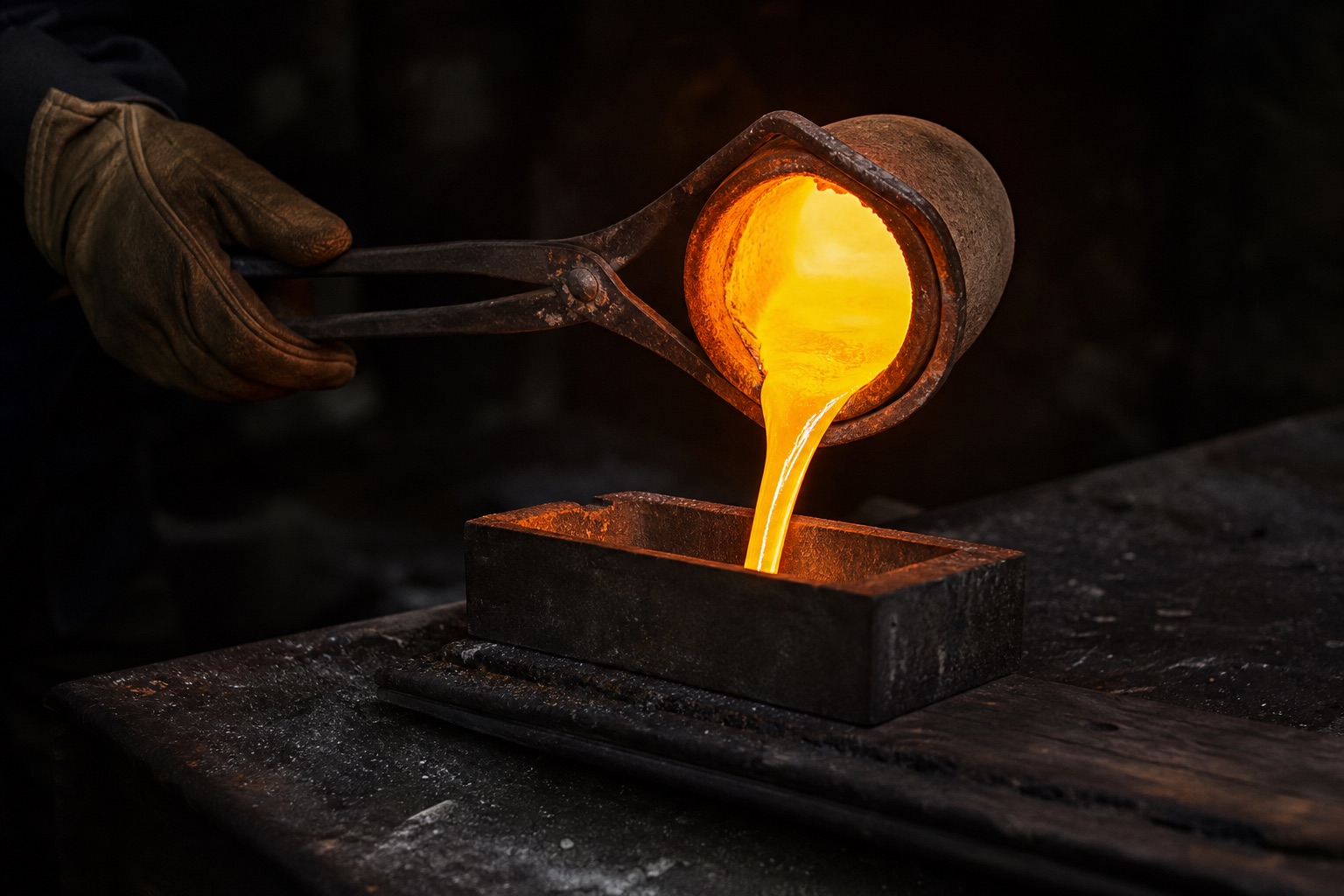
Casting grain and the sprues of last season's work go into the crucible with a pinch of borax. 22-karat runs just past 940 °C — the colour of apricot, not straw. It pours into the open ingot mould in one motion. Hesitation shows forever.
Every piece leaving this bench is 22-karat, hammered by one pair of hands, and struck with marks that will outlast us both. If you are marking something permanent, I make four commissions a season. Two remain.
Move your pointer — the facets catch your light
Nothing here is cast to shape or bought in. A band begins as loose gold and crosses the bench six times. The order is not a story device — skip a step and the metal tells on you.
Casting grain and the sprues of last season's work go into the crucible with a pinch of borax. 22-karat runs just past 940 °C — the colour of apricot, not straw. It pours into the open ingot mould in one motion. Hesitation shows forever.

The ingot goes through the rolling mill in passes, a quarter-turn each time, until it is square stock a little proud of final size. Cast gold is loose; forged gold is dense. Only dense metal can hold the record of a hammer.
Planishing is the slow part — hundreds of overlapping blows with a polished cross-peen, each one leaving a small flat plane. The facets are not a texture applied at the end. They are the strikes themselves, and no two bands can ever repeat.
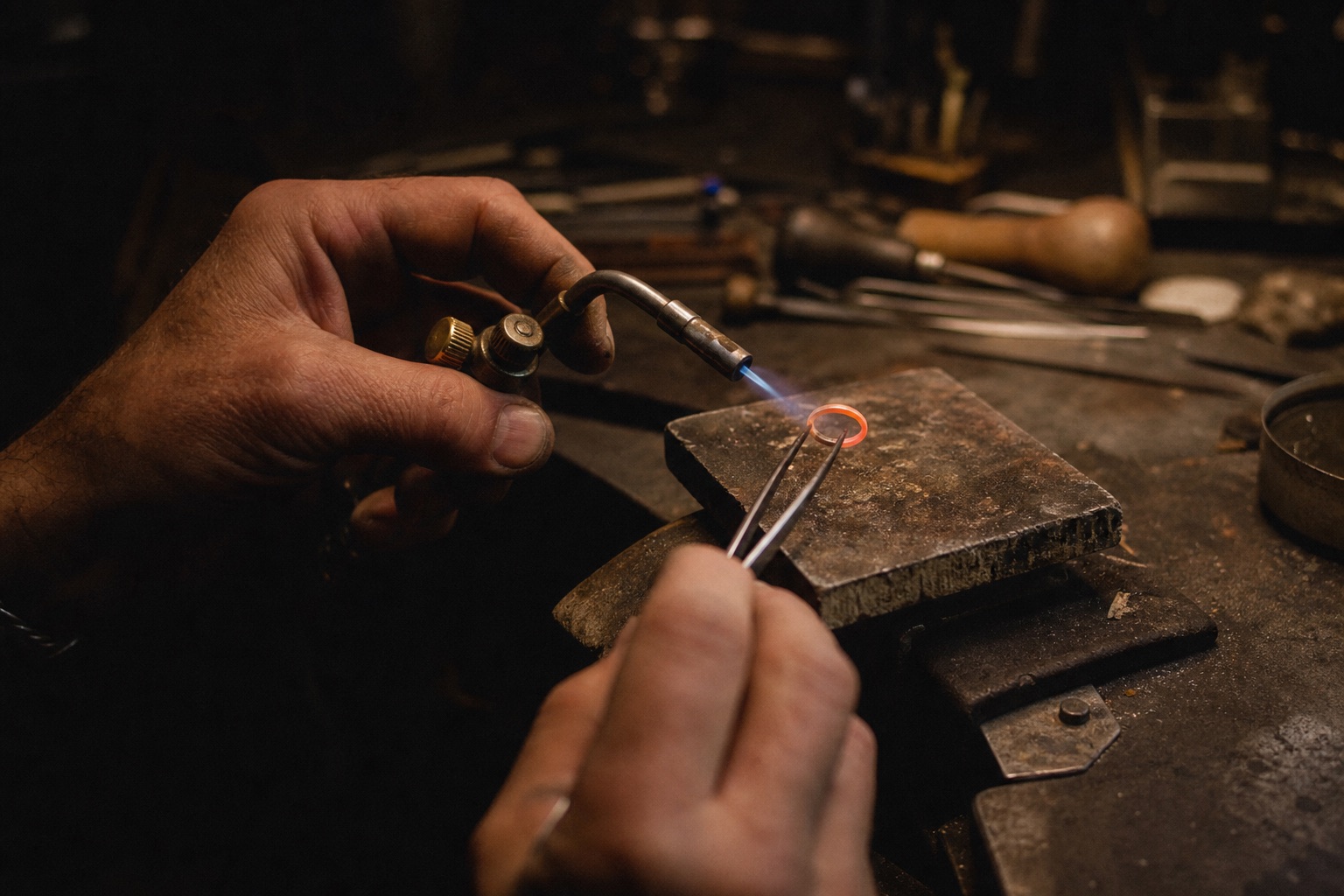
Hammering work-hardens gold until it fights back. The torch brings it to dull cherry — about 650 °C — then a quench in water. Hammer, anneal, hammer again; a band crosses the flame a dozen times before it is done arguing.
If a stone belongs, it is one stone — usually a garnet, cut for the piece rather than bought to fit. The bezel is raised from the same gold and burnished over by hand. No claws to catch a glove. Nothing set by machine.
Last come the punches: maker's mark, 916, the year letter. Each struck cold, in one blow. The marks are both signature and contract — they say who made it, what it is made of, and when, for as long as the gold exists.
Four is not a marketing number — it is what one goldsmith can hammer, anneal and hallmark in a season without hurrying any of it. The list closes when the fourth is spoken for.
A pair, melted from family gold brought to the bench — his grandmother's chain, her father's cufflink. Struck side by side.
For a first grandchild. The cipher is cut in reverse, so a century of letters can be sealed the right way round.
Tell me what it should mark — a marriage, a recovery, a life's work. The piece follows from the reason.
The last of the season. After this, the bench turns to spring and the list opens again in March.
Start with the reason, not the ring. Tell me what the piece must mark and I will answer within a week with a drawing, a gold weight, and an honest price. A commission takes six to nine weeks from first melt to hallmark.
Received at the bench
Thank you, friend. I read every letter myself and answer within the week — a drawing, a gold weight, an honest price. Nothing is struck until you say so.